Application readiness · China banking
Why FTN & NRA account applications
get rejected.
A registered company is only the beginning. The bank also needs a credible explanation of your business, its owners and the payments the account will handle.
This guide turns eight application concerns into practical preparation steps for overseas companies. It also explains what to ask when an application stalls or a bank says no.
The reason behind the review
The bank must be able to understand the relationship.
China’s customer due diligence rules, effective from 1 January 2026, require banks to verify customers and beneficial owners, understand the purpose of the relationship and apply checks proportionate to risk. Higher-risk cases require enhanced checks; a bank cannot establish a relationship if it cannot complete the required due diligence. [1]
In practice, a delay can mean the bank needs more evidence. A refusal can reflect unresolved concerns or a profile the bank cannot accept. The account type, branch capabilities and permitted transactions also matter. First confirm that the chosen bank can consider the account and your proposed use.
A new company, a small team, a simple website or several ownership layers does not, by itself, prove that a business is illegitimate. The issue is whether the full application can be verified. This guide does not claim a rejection rate or a universal bank approval checklist.
Eight areas to review
Where an application can lose clarity.
These are practical preparation prompts, not a ranking of refusal reasons. Use genuine records to explain your circumstances and ask the bank what further evidence it needs.
Little evidence of actual operations
A company certificate says that the entity exists. Your application still needs to explain how the business operates, especially if it is new, remote or has no employees.
Prepare A short operating plan, the roles of directors or contractors, and genuine orders or other available commercial evidence. Label projections as projections.
An unclear business model
“International trade” is too broad to explain a particular payment. An unclear account of the goods, services, customers and suppliers leaves gaps in the application.
Prepare Describe one real or planned transaction from order to delivery and payment. Separate signed contracts from proposals or discussions.
Ownership that is hard to verify
Several holding companies, changes of shareholders or different names across records can make the ownership story difficult to follow. Complexity is not the same as concealment.
Prepare A dated ownership chart, relevant registers and the identity records the bank requests. Explain the individuals who ultimately own or control the business.
Unresolved country or industry concerns
Do not assume that every bank will accept the same jurisdictions, counterparties or sectors. A proposed activity may need specialist review or fall outside the bank’s current policy.
Prepare Disclose the countries and sectors involved at the outset. Ask the bank to confirm its policy and any applicable sanctions or licensing questions before preparing a full file.
Payments that do not match the business
Rapid onward payments or third-party payments need a clear commercial explanation. A diagram showing money moving in and out is incomplete without the underlying business.
Prepare Map each payer and recipient to a contract, invoice or other genuine record. Explain timing, amounts and any third-party role rather than leaving it implicit.
An unexplained source of funds
“Business funds” does not distinguish customer receipts from shareholder capital or a loan. The explanation should identify the actual source and intended use.
Prepare Organise the available evidence for each funding source, such as existing statements, sales records, capital records or loan agreements. Confirm what the bank will accept.
An account purpose that does not add up
Why does this company need this account? A forecast with very large volumes but no supporting commercial basis can make that question harder to answer.
Prepare Explain the actual settlement need, counterparties, currencies and expected activity. State the assumptions behind forecasts and confirm the proposed transactions are supported.
Incomplete or inconsistent documents
Different names, addresses, ownership details or figures across forms and records can create avoidable follow-up questions. Missing authorisations can also leave the file incomplete.
Prepare Check the file against the bank’s current list. Explain legitimate differences, attach requested updates, and confirm translation, certification and signing requirements.
View the illustrated overview
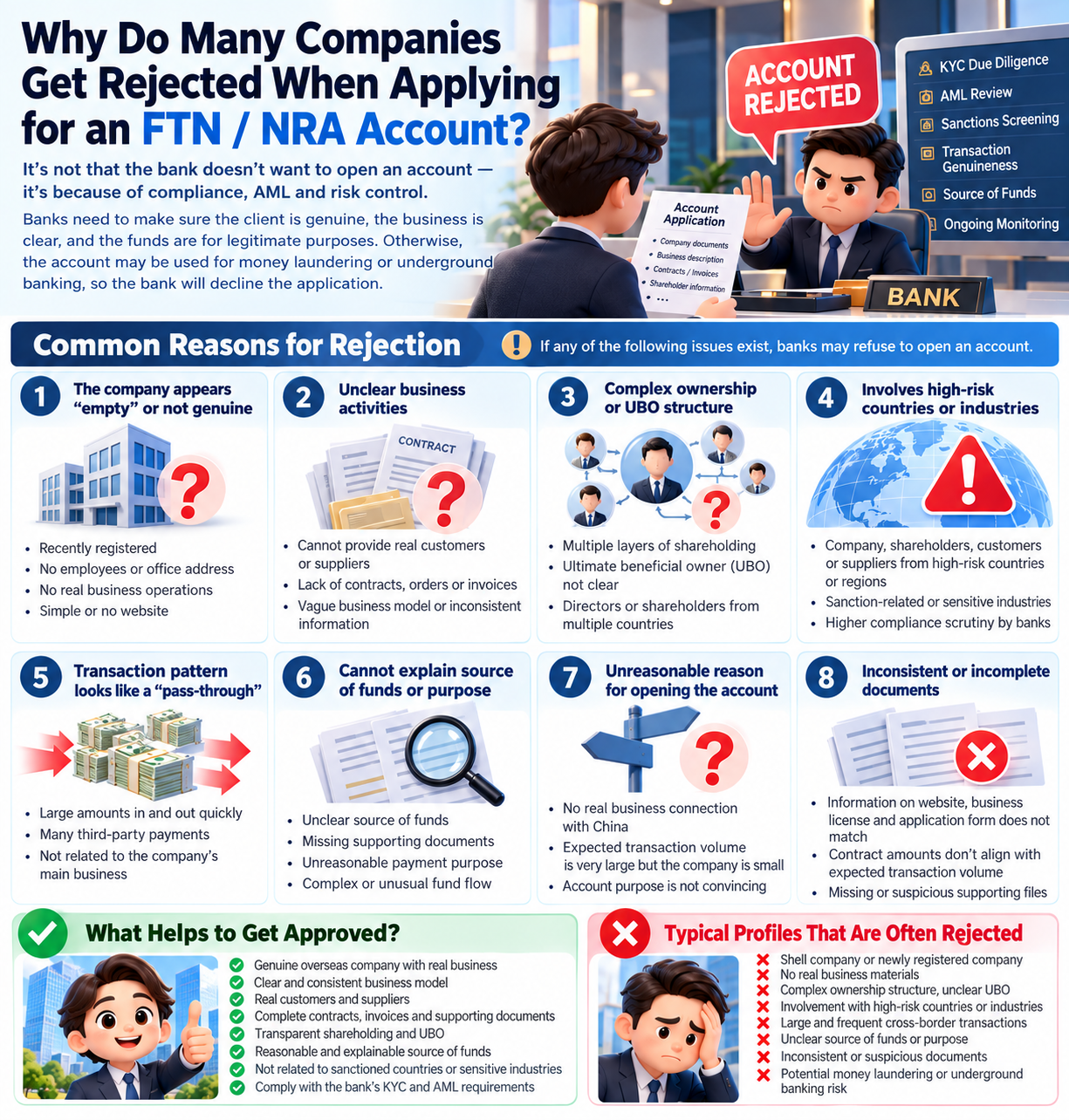
Turn the explanation into a file
Prepare one coherent application pack.
Ask the bank for its current checklist first. The following is a practical starting point; it is not a substitute for the documents that bank requests.
Company & authority
Registration records, constitutional documents and the required account-opening authorisation. Ask which current registry extracts, certifications and signatures are needed.
Ownership & people
A clear ownership chart and the requested records for beneficial owners, directors and authorised signatories. Keep names and ownership dates consistent across the file.
Business & counterparties
A concise business summary, genuine contracts or orders, and available invoices or delivery records. Explain what is already operating and what is still planned.
Funds & expected activity
Who pays the company, whom it pays, why, and in which currencies. Distinguish actual historical activity from forecasts, and identify evidence for funding sources.
A useful starting summary
Make the first conversation concrete.
“Our company is registered in [country] and sells [goods or services] to [customer type]. We need this account for [commercial purpose]. We expect [currencies, volumes and payment frequency], based on [orders or forecast assumptions]. Our main counterparties are in [countries], and funds come from [identified sources].”
Use your real circumstances. Where evidence is not yet available, explain the gap rather than inventing a trading history.
When the bank says no
Understand the issue before applying again.
- Clarify the status.
Is the bank requesting more information, unable to offer the account, or declining the customer relationship? Ask what it can share; a detailed explanation may not be available.
- Identify what can actually be addressed.
If the issue is a missing or inconsistent record, ask whether a corrected file can be considered. If the proposed activity is outside policy, extra paperwork may not change the outcome.
- Update the underlying explanation.
Resolve genuine gaps and keep the information consistent. Reconsider the account’s suitability with the bank instead of sending the same incomplete application elsewhere.
- Confirm the next step.
Ask whether resubmission is possible and what it requires. Keep a record of the bank’s requests and the documents supplied. There is no universal approval deadline.
Common questions
What applicants often misunderstand.
Is a newly registered company automatically rejected?
No universal rule is established by the sources below. A new business may have limited evidence, so clearly distinguish existing activity from plans and confirm whether the bank can consider that profile. A website or a company certificate alone does not settle the assessment.
Is FTN easier to open than NRA?
Do not treat FTN as a route around due diligence. In November 2024, Shanghai financial authorities reported that Bank of Communications had unified application materials, admission standards and management across its overseas-institution accounts, including NRA and FTN. That is evidence about one bank, not every bank. [3]
Does a large transaction forecast mean the company will be declined?
A number alone does not establish the result. Show how the forecast was calculated, what supports it and how the payments relate to the company’s business. Avoid presenting planned turnover as completed trading activity.
Can Supro guarantee approval or reverse a refusal?
No. We help organise genuine supporting documents, explain the proposed account use and coordinate questions with the bank in English. The bank makes the admission decision, including whether it will reconsider an application.
Public references
Sources & scope.
The eight concerns and preparation steps are practical editorial guidance, not a published bank rejection list. The references establish the due diligence framework and specific bank examples. Requirements and account availability must be confirmed for your circumstances.
- Customer Due Diligence and Customer Identity and Transaction Record Retention Measures — Order No. 11 of 2025, effective 1 January 2026; in particular Articles 7, 20, 28 and 30. Official regulatory text published by the Shanghai government (Chinese).
- Bank of Communications: FTN account service and overseas-company document lists — bank product information (Chinese).
- Bank of Communications’ integrated management of overseas-institution accounts — Shanghai financial authorities, 26 November 2024 (Chinese).
General information for application preparation. It does not replace the bank’s assessment or advice on your particular legal or regulatory obligations.